If you’re considering orthodontic treatment, one of the most common questions people ask is:
“Should I choose braces or clear aligners?”
Both options can be effective for straightening teeth, improving bite alignment, and creating a more balanced smile. However, the best treatment for you depends on factors such as the complexity of your case, your lifestyle, and your treatment goals.
In this guide, we’ll explain the key differences between braces and clear aligners to help you understand which option may be most suitable.
💡 Quick answer: Both braces and clear aligners can effectively straighten teeth. Braces can treat a wide range of orthodontic problems (including more complex cases), while clear aligners are often chosen for their discreet appearance and removability. The best option depends on your individual assessment and treatment plan.
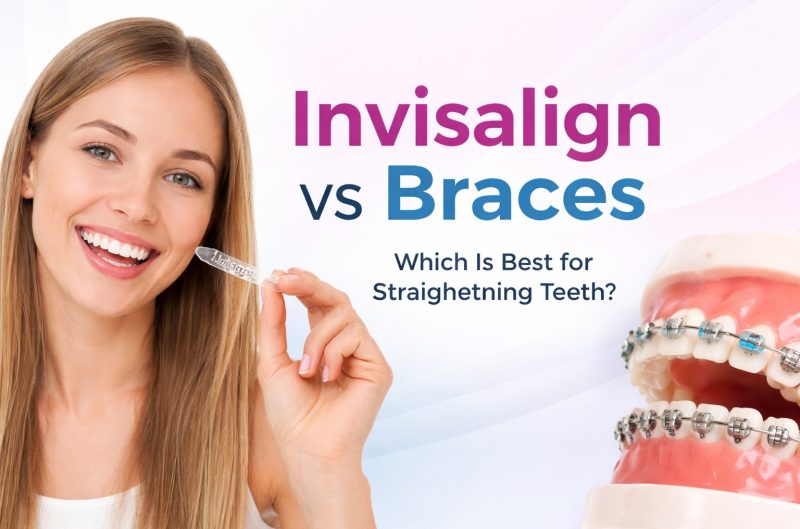
Traditional braces use a system of small brackets attached to the teeth and connected by a wire.
Over time, the wire is adjusted to apply gentle pressure that gradually moves teeth into the correct position.
Braces are widely used to help with orthodontic issues such as:
Because braces are fixed to the teeth, they work continuously throughout treatment.
To learn more about brace options, you can also read about ceramic braces (a more discreet fixed brace option) and our fixed braces treatment page.
Clear aligners are a modern orthodontic option that uses a series of transparent removable trays to move teeth gradually.
Each aligner is slightly different and moves teeth in small stages until the desired position is achieved.
Patients typically wear each aligner for around one to two weeks before moving to the next in the series.
Clear aligners are popular because they are:
Important: aligners must be worn for most of the day (commonly around 20–22 hours) for treatment to work effectively.
If you’d like to explore whether aligners could be suitable for you, visit our Invisalign page for an overview of how clear aligner treatment works.
Both treatments aim to achieve the same goal — moving teeth into a healthier, more balanced position. But there are some important differences between the two approaches.
| Feature | Traditional Braces | Clear Aligners |
|---|---|---|
| Appearance | Visible brackets and wires | Nearly invisible transparent trays |
| Removable | Fixed to the teeth | Removable for eating and brushing |
| Suitable for complex cases | Often recommended | May be suitable for mild–moderate cases |
| Cleaning teeth | Requires careful cleaning around brackets | Easier to brush and floss normally |
| Comfort | May cause irritation initially | Smooth trays with no wires |
Clear aligners are designed to be discreet, which is why many adults choose them. Braces are more visible because brackets are attached to the teeth.
Aligners can be removed when eating, drinking (other than water), and brushing teeth. Braces remain fixed to the teeth throughout treatment.
Braces are sometimes recommended for more complex orthodontic cases involving significant tooth movement or bite correction. Clear aligners may be suitable for mild to moderate alignment issues, depending on the treatment plan.
Because aligners can be removed, it is often easier to brush and floss normally. With braces, patients need to take extra care cleaning around brackets and wires.
Treatment time depends largely on the complexity of the case, rather than the appliance used.
Many orthodontic treatments typically take between 12 and 24 months, although some cases may be shorter or longer.
In some situations, aligner treatment may appear faster because it involves fewer visible adjustments. However, both systems work gradually to move teeth safely.
Your dentist or orthodontist can estimate treatment time following a consultation.
Many adults prefer clear aligners because they are discreet and removable.
However, braces remain an effective and widely used orthodontic treatment, particularly when more complex tooth movements are required.
The best option depends on:
A consultation is the best way to determine which treatment approach may be suitable. For a broader overview of the options available, visit our Orthodontics page.
If you’re considering braces or clear aligners, the first step is an orthodontic consultation.
During this appointment, your clinician may:
This assessment allows a personalised orthodontic treatment plan to be created.
You may also find it helpful to read our guide on what to expect after orthodontic treatment, including retainers and long-term maintenance.
✅ Tip: If you already know you’re leaning one way, tell your clinician — it helps them discuss the pros/cons in the context of your teeth, lifestyle, and goals.
Are clear aligners as effective as braces?
Clear aligners can be effective for many orthodontic cases. Braces may sometimes be recommended for more complex tooth movements.
Are braces cheaper than clear aligners?
Costs vary depending on the system used and the complexity of the case. A consultation is the best way to understand likely fees for your treatment plan.
Do braces work faster than aligners?
Treatment time depends on the individual case rather than the appliance. Many treatments take between 12 and 24 months.
Can adults get braces?
Yes. Orthodontic treatment is increasingly common for adults who want to improve the alignment and function of their teeth.
Both braces and clear aligners are effective orthodontic treatments that can improve the alignment and function of your teeth.
The most suitable option depends on your individual case and goals — and a consultation allows your teeth and bite to be assessed so you can make an informed choice.
Book an orthodontic consultation to find out whether braces or clear aligners are more suitable for your teeth and bite.
Or browse: Orthodontics • Clear aligners • Braces

Private dentist in Edwalton near West Bridgford, Nottingham. Dental implants, braces, cosmetic and general care. Book your appointment today.