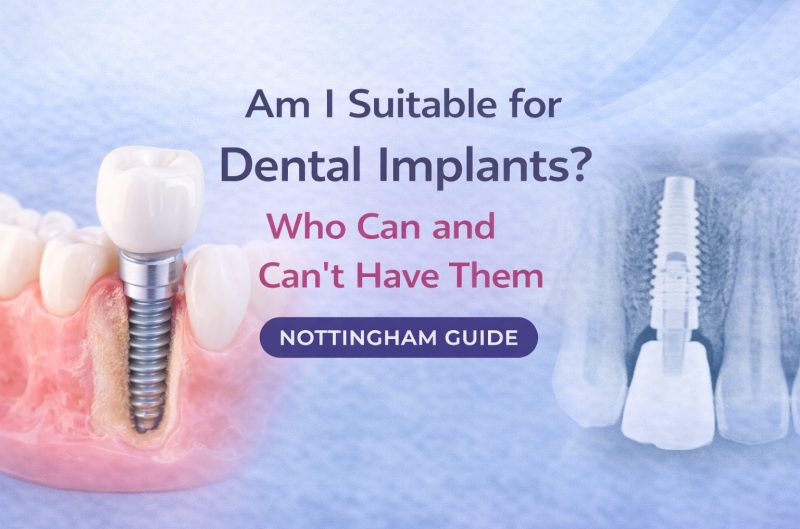
If you’re considering replacing a missing tooth, one of the most common questions is:
“Am I actually suitable for dental implants?”
Dental implants are widely used to replace missing teeth and can provide a stable, long-term solution. However, not every patient is automatically suitable for implant treatment.
In this guide, we’ll explain what dentists look for when assessing suitability, what factors may affect treatment, and what options may still be available if implants are not immediately suitable.
💡 Quick Answer:
🦷 Many people are suitable for dental implants. Suitability depends on factors such as bone levels, gum health, general health, and lifestyle habits. A clinical assessment is required to determine the most appropriate treatment plan.
Dental implants require a healthy foundation in order to function successfully over the long term.
Your dentist will usually assess several key factors before recommending treatment.
Dental implants are placed into the jawbone, so there needs to be enough bone to hold the implant securely.
If bone levels are reduced, this doesn’t necessarily mean implants are not possible. In some cases, additional procedures such as bone grafting may be recommended.
Gum health plays an important role in implant success.
If you have a history of gum disease, treatment may still be possible with careful planning and ongoing maintenance. You can read more in our guide on dental implants and gum disease.
Dental implants require the same level of care as natural teeth.
This includes brushing, cleaning between teeth, and attending regular dental visits to help maintain long-term health.
Certain medical conditions or medications may affect healing.
Your dentist will review your medical history to ensure implant treatment is appropriate and safe.
Many patients are suitable for dental implants, but there are situations where additional planning may be needed.
Factors that can influence suitability include:
In many cases, these factors can be managed or improved before treatment.
Dental implant treatment is highly individual, and suitability is determined through careful assessment rather than a simple yes/no answer.
If you’ve previously been told you’re not suitable for dental implants, it doesn’t always mean treatment is impossible.
Advances in implant dentistry mean that many patients who were previously unsuitable may now have options.
These may include:
In some cases, alternative treatments such as bridges or dentures may still be recommended.
Dental implants have high success rates when carefully planned and maintained.
Many long-term studies report success rates above 90–95% in appropriate cases.
If you’d like to explore this further, you can read our guide on how successful dental implants are.
Long-term outcomes also depend on factors such as oral hygiene, maintenance, and lifestyle habits.
Our article on how long dental implants last explains this in more detail.
Many patients are concerned about discomfort during treatment.
Implant placement is typically carried out under local anaesthetic, and most patients report that it is more comfortable than they expected.
You can read more about this in our article on whether dental implants are painful.
The cost of dental implants varies depending on the number of implants required and the complexity of treatment.
This may include factors such as bone grafting, restoration type, and overall treatment planning.
For a detailed breakdown, see our guide on dental implant costs in the UK.
Dental implants are rarely available on the NHS and are usually only provided in specific medical situations.
Most patients receive implant treatment privately.
Learn more in our guide on dental implants on the NHS.
The best way to determine suitability is through a consultation.
During this appointment, your dentist may:
This allows a personalised treatment plan to be created based on your individual needs.
Many patients are suitable for dental implants, but treatment is always tailored to the individual.
Factors such as bone levels, gum health, and general health all play a role in determining the most appropriate approach.
If implants are not immediately suitable, there may still be alternative options or preparatory treatments available.
A professional assessment is the most reliable way to understand what is possible for your specific situation.
Book a consultation to find out whether dental implant treatment may be suitable for you.
Or browse:
Dental implants overview

Private dentist in Edwalton near West Bridgford, Nottingham. Dental implants, braces, cosmetic and general care. Book your appointment today.