If you’re considering dental implants, one of the questions that may come up during treatment planning is:
“Can the implant be placed straight away, or do I need to wait?”
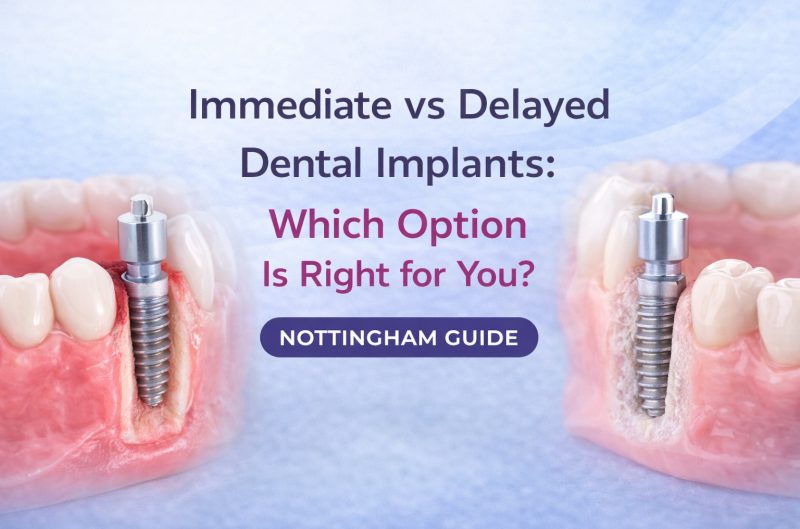
In implant dentistry, there are generally two main timing approaches when replacing a missing tooth:
Both techniques can be effective, but the most suitable option depends on factors such as bone health, infection, and the condition of the surrounding tissues.
In this guide, we’ll explain what immediate and delayed implants mean, how they differ, and how dentists decide which option may be appropriate.
If you’re still researching implant treatment more broadly, you may also find it useful to read our guide to how successful dental implants are.
💡 Quick Answer:
🦷 Immediate implants are placed at the same time a tooth is removed, while delayed implants are placed after the area has healed. Both approaches can be successful when carefully planned. The right option depends on factors such as infection, bone levels, and overall oral health.
An immediate implant is placed at the same appointment when a tooth is removed.
Once the tooth is extracted, the dentist places the implant directly into the socket where the root previously sat.
This approach can reduce the number of surgical appointments and shorten the overall treatment timeline.
Immediate implants are often considered when:
In some situations, a temporary tooth may also be attached soon after placement, depending on the clinical circumstances.
Patients sometimes worry that implant placement will be uncomfortable, but in suitable cases the procedure is often better tolerated than they expect. You can read more in our article Are Dental Implants Painful? Myth vs Reality.
A delayed implant is placed after the extraction site has healed.
In this approach, the tooth is removed first, and the area is allowed to heal before implant placement takes place.
Healing typically takes several weeks to a few months, depending on the condition of the bone and gums.
Delayed implants are often recommended when:
This approach allows the dentist to place the implant in healthy, healed bone.
For some patients, this more staged approach can provide a predictable long-term foundation, particularly where the extraction site needs time to recover properly.
The timing of implant placement is important because it affects the stability of the implant and the long-term health of the surrounding tissues.
Dentists consider several factors when deciding between immediate and delayed placement.
Dental implants need sufficient bone to support them. If bone levels are reduced or damaged, additional healing time may be needed.
If the tooth being removed has a significant infection, delaying implant placement may allow the area to heal properly before surgery.
Healthy gum tissue helps protect the implant and contributes to good long-term outcomes.
Some cases require additional procedures such as bone grafting, which may influence the timing of implant placement.
If you have previously had gum disease, this can also affect treatment planning and maintenance. Our guide on whether you can get dental implants after gum disease explains this in more detail.
Immediate implants can offer some advantages in suitable cases.
Potential benefits may include:
However, immediate placement is not suitable for every situation.
For some patients, allowing the area to heal first can create a more predictable foundation for implant placement.
Your dentist will recommend the approach that provides the best long-term outcome.
Long-term success depends not just on timing, but on careful planning, good oral hygiene, and appropriate maintenance. If you’d like to understand the bigger picture, see our article on how long dental implants last.
Sometimes the term “same-day teeth” is used in implant dentistry.
This usually refers to situations where a temporary tooth or bridge is attached shortly after implant placement.
However, even when temporary teeth are placed quickly, the implant still needs time to integrate with the bone before a final restoration is fitted.
Healing and integration typically take several weeks to a few months.
Choosing between immediate and delayed implants involves careful clinical assessment.
Your dentist will usually evaluate:
These factors help determine which timing approach may offer the most predictable long-term outcome.
The cost of treatment can also vary depending on complexity and whether additional procedures are required. You can read more in our guide to how much dental implants cost in the UK.
Is it better to get an implant immediately after extraction?
In some cases, immediate placement is possible and can reduce treatment time. However, it depends on the condition of the bone and gums.
How long do you have to wait for a delayed implant?
Healing time can vary, but implants are commonly placed several weeks to a few months after a tooth extraction.
Can I have a tooth the same day as my implant?
In some cases, a temporary crown or bridge may be fitted soon after implant placement. Your dentist will advise whether this is appropriate for your situation.
Does immediate implant placement heal faster?
Immediate placement can reduce the number of procedures, but the implant still needs time to integrate with the bone before final restoration.
Both immediate and delayed dental implants are well-established treatment approaches.
The right option depends on your individual circumstances, including the condition of the bone, gums, and surrounding tissues.
A consultation with an experienced implant dentist allows your mouth to be assessed properly and ensures treatment is planned in a way that supports long-term implant health.
Every patient’s situation is different, so personalised assessment is essential before deciding on the best timing for implant placement.
Book a consultation to discuss your treatment options and find out whether immediate or delayed implant placement may be suitable for you.
Or browse:
Dental implants overview • How successful are dental implants?

Private dentist in Edwalton near West Bridgford, Nottingham. Dental implants, braces, cosmetic and general care. Book your appointment today.